




Introduction
The landscape of portable gaming has never been more vibrant, with two titans dominating the conversation among USA gamers: the Nintendo Switch OLED and the Steam Deck. While both offer the allure of gaming on the go, they cater to distinctly different preferences and deliver unique experiences. Deciding which device is the right fit for your gaming habits and budget requires a thorough understanding of their strengths, weaknesses, and target ecosystems. This detailed comparison aims to equip you with the insights necessary to make an informed purchasing decision.
Whether you prioritize exclusive first-party titles and a family-friendly experience, or robust PC gaming performance and an open ecosystem, this guide will dissect every critical aspect, from display quality and processing power to game libraries and ergonomics, ensuring you select the portable console that best aligns with your gaming lifestyle.
Comparison Table
| Feature | Nintendo Switch OLED | Steam Deck (All Models) |
|---|---|---|
| Display | 7-inch OLED, 1280×720 (Handheld) | 7-inch LCD (original/64GB/256GB/512GB), 7.4-inch OLED (OLED models), 1280×800 (Handheld) |
| Processor (CPU/GPU) | Custom NVIDIA Tegra X1 (Maxwell-based GPU) | Custom AMD APU (Zen 2 CPU, RDNA 2 GPU) |
| RAM | 4GB LPDDR4 | 16GB LPDDR5 |
| Internal Storage | 64GB eMMC | 64GB eMMC, 256GB NVMe SSD, 512GB NVMe SSD, 1TB NVMe SSD (OLED) |
| Expandable Storage | MicroSD card slot | MicroSD card slot |
| Operating System | Nintendo OS | SteamOS 3.0 (Linux-based) |
| Resolution (Handheld) | 720p | 800p |
| Resolution (Docked/External) | Up to 1080p via HDMI | Up to 8K @ 60Hz or 4K @ 120Hz via USB-C to DisplayPort/HDMI |
| Battery Life | 4.5 – 9 hours (game dependent) | 2 – 8 hours (game dependent), 3-12 hours (OLED models) |
| Controls | Detachable Joy-Cons, Pro Controller support | Integrated gamepad, trackpads, gyro, back buttons |
| Game Library | Nintendo eShop exclusives, select third-party titles | Steam Library (PC games), other PC launchers (Epic, GOG), emulation |
| Online Services | Nintendo Switch Online (paid subscription) | Steam multiplayer services (free), optional game-specific subscriptions |
| Connectivity | Wi-Fi (ac), Bluetooth 4.1 | Wi-Fi 5 (ac) / Wi-Fi 6E (OLED), Bluetooth 5.0 / 5.3 (OLED) |
| Price (USA MSRP, approx.) | $349.99 | Starts at $399 (64GB) / $449 (256GB) / $549 (512GB), OLED from $549 (512GB) / $649 (1TB) |
| Primary Use Case | Portable & TV console, family gaming, exclusive titles | Portable PC gaming, extensive library, customization |
Nintendo Switch OLED: A Closer Look
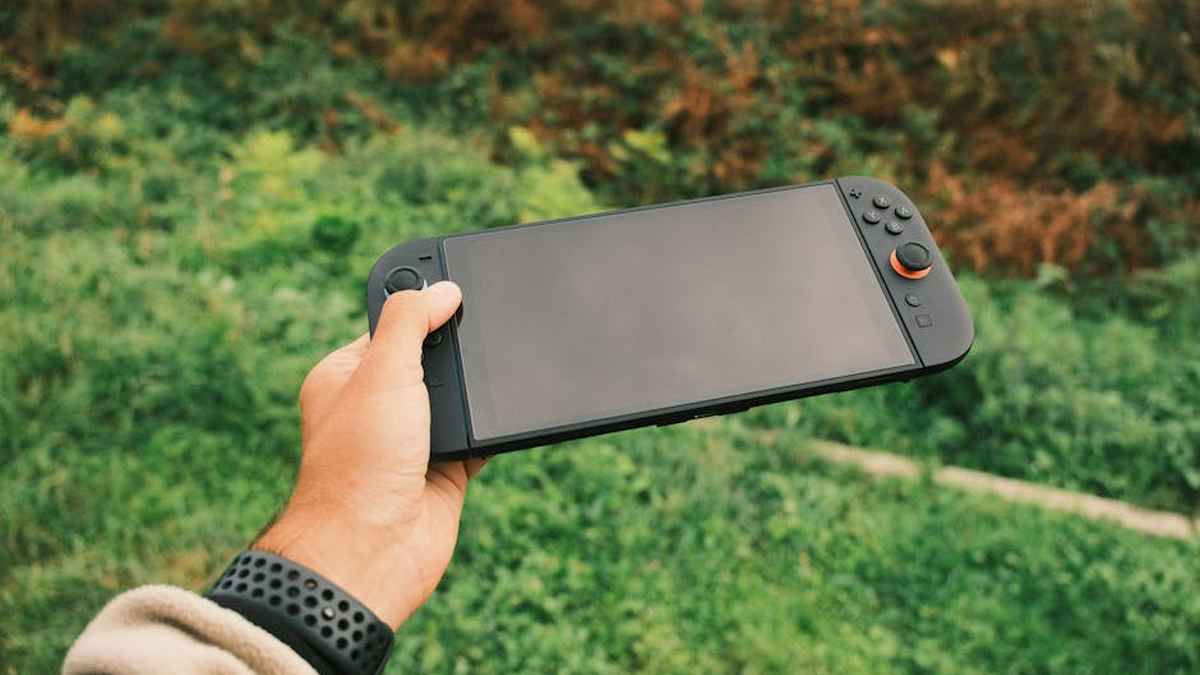
The Nintendo Switch OLED model, released in October 2021, represents an iterative enhancement to Nintendo’s incredibly popular hybrid console. While it doesn’t offer a significant boost in processing power over its predecessors, its primary upgrade lies in its stunning 7-inch OLED display. This vibrant screen, coupled with an improved kickstand and enhanced audio, refines the handheld and tabletop gaming experience. The Switch OLED continues to embody Nintendo’s philosophy of unique gameplay experiences, leveraging its detachable Joy-Cons for versatile playstyles, from solo adventures to local multiplayer fun. It remains a gateway to Nintendo’s celebrated first-party franchises like Mario, Zelda, and Pokémon, which are exclusive to the platform.
Related: NVIDIA GeForce RTX 4070 Super Review: Performance & Price for High-End PC Builds in the USA
Steam Deck: A Deeper Dive
Valve’s Steam Deck, first launched in February 2022, revolutionized portable gaming by bringing the vast library of PC games into a handheld form factor. More than just a console, the Steam Deck is a portable PC designed specifically for gaming. Powered by a custom AMD APU, it boasts significantly more processing muscle than the Switch OLED, capable of running many modern AAA titles at respectable settings. Its Linux-based SteamOS is optimized for handheld play but remains an open platform, allowing users extensive customization, including installing Windows or other operating systems. The Steam Deck’s robust control scheme, featuring dual trackpads, gyro controls, and programmable back buttons, offers unparalleled flexibility for a wide array of PC games.
Related: Logitech G Pro X Superlight 2 Review: The Ultimate Wireless Gaming Mouse for Esports Players
Feature Comparison
Display Quality
The Nintendo Switch OLED’s namesake feature is its 7-inch OLED panel. This display offers incredibly vibrant colors, deep blacks, and excellent contrast, making games pop, especially in darker scenes. It’s a noticeable upgrade for handheld play. The Steam Deck, on the other hand, comes with both LCD and OLED options. The original LCD models feature a 7-inch (or 7.4-inch for LCD) 1280×800 resolution screen, which is good but cannot match the contrast and color saturation of an OLED. However, the Steam Deck OLED models offer a larger 7.4-inch OLED display with HDR support and a higher refresh rate (up to 90Hz), arguably surpassing the Switch OLED in visual fidelity and responsiveness. For most games, the difference in resolution (720p vs. 800p) is less impactful than the panel technology itself.
Related: PlayStation 5 Slim Review: Is Sony’s New Console Worth Upgrading For in the USA?
Performance & Graphics
This is where the Steam Deck truly asserts its dominance. With its custom AMD Zen 2 CPU and RDNA 2 GPU, the Steam Deck offers performance comparable to a modern entry-level gaming PC. It can run a wide range of current AAA titles, often at medium settings, delivering frame rates that are generally stable and playable. The Nintendo Switch OLED, with its NVIDIA Tegra X1 chip (based on older Maxwell architecture), is significantly less powerful. While it capably runs Nintendo’s optimized first-party titles, third-party ports often see substantial graphical downgrades, lower resolutions, and less consistent frame rates to accommodate the hardware. If raw power and pushing graphical fidelity are priorities, the Steam Deck is the clear winner.
Related: Best High Refresh Rate Gaming Monitors for Competitive Play in USA (2026)
Game Library & Ecosystem
The game libraries are fundamentally different. The Nintendo Switch OLED taps into the Nintendo eShop, offering access to an unparalleled collection of first-party exclusives like The Legend of Zelda: Tears of the Kingdom, Super Mario Odyssey, and Pokémon Scarlet/Violet. These games are meticulously optimized for the hardware and often define the system’s appeal. The Steam Deck, leveraging SteamOS, opens up access to your entire Steam library, potentially thousands of PC games you already own. While not all games are “Deck Verified,” the vast majority of PC titles can be played with varying degrees of tweaking. Furthermore, the Steam Deck’s open nature allows for the installation of other PC launchers (Epic Games Store, GOG, Battle.net) and robust emulation capabilities, offering an incredibly diverse gaming landscape unmatched by any dedicated console.
Related: PS5 Slim vs Xbox Series X: Which Console is Best for 4K Gaming in 2024?
Portability & Ergonomics
The Nintendo Switch OLED is the more compact and lighter device. Its slimmer profile and detachable Joy-Cons make it easier to slip into smaller bags or pockets, and it feels lighter for extended handheld sessions. The Steam Deck, particularly the OLED model, is a larger and heavier device, built for substantial internal components and a more robust cooling system. While its ergonomic grips are comfortable for many users, its size can make it less “pocketable” and might be more cumbersome for some. The Switch’s ability to detach controllers also offers more versatile play modes (tabletop with separate controllers).
Battery Life
Battery life varies significantly based on the game and settings. The Switch OLED generally offers between 4.5 to 9 hours, with less demanding games like indie titles pushing towards the higher end, and more intensive first-party titles closer to the lower end. The Steam Deck (LCD models) typically ranges from 2 to 8 hours. Running demanding AAA games on the Steam Deck can drain the battery in as little as 90 minutes to 2 hours. The Steam Deck OLED models significantly improve this, often achieving 3 to 12 hours thanks to a larger battery and more power-efficient OLED screen and APU. For consistently long sessions with graphically intensive games, both may require power management or an external battery pack.
Price & Value
In the USA, the Nintendo Switch OLED typically retails for $349.99. The Steam Deck has multiple configurations, with LCD models starting at $399 (64GB) and going up to $549 (512GB), and OLED models starting at $549 (512GB) and $649 (1TB). On paper, the Steam Deck offers substantially more raw performance and an arguably larger library for a similar or slightly higher initial investment, especially if you opt for the base models. However, the Switch’s games are often cheaper during sales, and its first-party exclusives hold their value well. The “value” ultimately depends on your priority: pure hardware power and library size (Steam Deck) or access to specific exclusive titles and a more streamlined console experience (Switch OLED).
Pros and Cons for Both
Nintendo Switch OLED
Pros:
- Stunning OLED Display: Vibrant colors and deep blacks enhance handheld gaming.
- Exclusive First-Party Games: Access to critically acclaimed titles like Zelda, Mario, and Pokémon.
- Hybrid Design: Seamlessly transitions between handheld, tabletop, and TV modes.
- Superior Portability: Lighter, more compact, and easier to carry.
- Family-Friendly: Broad appeal across all ages, with numerous local multiplayer options.
- Intuitive OS: Simple, fast, and easy to navigate user interface.
- Dock Included: Comes with a dock for TV output right out of the box.
Cons:
- Lower Performance: Significantly less powerful than the Steam Deck, leading to compromised third-party ports.
- Smaller Game Library (Exclusives Only): Limited to games available on the eShop; no access to PC libraries.
- Proprietary Controllers: Joy-Con drift remains a potential issue; replacement/repair can be costly.
- Higher Game Prices: Nintendo first-party titles rarely see deep discounts.
- Online Service Required: Nintendo Switch Online subscription needed for most online multiplayer.
- Limited Customization: Closed ecosystem with minimal user configuration options.
Steam Deck
Pros:
- Powerful Hardware: Capable of running many modern AAA PC games at playable settings.
- Vast Game Library: Access to your entire Steam library and other PC game launchers, plus emulation.
- Open Ecosystem: Highly customizable, allows installing Windows, mods, and other software.
- Versatile Controls: Integrated trackpads, gyro, and programmable back buttons for PC-level precision.
- Multiple Storage Options: NVMe SSDs for faster load times, with MicroSD expansion.
- Cost-Effective PC Gaming: Offers immense value for a portable PC gaming experience.
- Active Community Support: Robust community for troubleshooting and optimization tips.
Cons:
- Larger & Heavier: Less portable and potentially less comfortable for smaller hands during long sessions.
- Battery Life for AAA Games: Demanding titles can drain the battery quickly (less so on OLED models).
- Learning Curve: SteamOS requires some familiarity with PC gaming concepts; not as plug-and-play as Switch.
- Game Compatibility Not : While many work, some PC games may require tweaking or not run optimally.
- Fan Noise: Can be noticeable, especially under heavy load (improved on OLED models).
- Accessories Often Required: Dock, external display, keyboard/mouse for a full PC experience are separate purchases.
- No Nintendo Exclusives: Cannot play Mario, Zelda, or other Nintendo first-party titles natively.
Which one is better for whom?
Choose the Nintendo Switch OLED if:
- You are a fan of Nintendo’s first-party exclusive games (Zelda, Mario, Pokémon, Animal Crossing).
- You primarily game in handheld or tabletop mode and value screen quality and portability.
- You prefer a simple, streamlined, and family-friendly gaming experience.
- You frequently play local multiplayer games with friends or family.
- You’re looking for a device that seamlessly docks to your TV without extra setup.
- Your budget is strictly around the $350 mark.
Choose the Steam Deck if:
- You have an extensive Steam library of PC games you want to play on the go.
- You prioritize raw performance and graphical fidelity for modern AAA titles.
- You appreciate an open, customizable platform where you can tinker with settings, install other launchers, or even run Windows.
- You are comfortable with a larger, heavier device for the benefit of PC-grade power.
- You are interested in emulation of older console systems.
- You’re looking for a versatile portable device that can double as a mini-PC (with accessories).
Final Verdict
The choice between the Nintendo Switch OLED and the Steam Deck is not about one being definitively “better” than the other, but rather about which device better serves your specific gaming needs and preferences.
The Nintendo Switch OLED excels as a polished, user-friendly, and highly portable console that delivers an unparalleled experience for Nintendo’s iconic first-party titles. Its vibrant OLED screen makes every exclusive adventure shine, and its hybrid nature ensures it’s ready for any gaming scenario, from solo handheld sessions to family game night on the TV. It’s the perfect choice for those seeking a dedicated console experience with a focus on unique, high-quality exclusive games and ease of use.
The Steam Deck, conversely, is a portable powerhouse designed for the discerning PC gamer. It opens up a universe of PC titles, offering a level of performance and customization that no other handheld console can match. If your priority is playing the latest AAA games on the go, diving into your existing Steam library, or experimenting with the vast possibilities of an open PC platform, the Steam Deck is an unmatched proposition. Its larger size and steeper learning curve are minor trade-offs for the immense power and flexibility it offers.
Ultimately, consider your existing game library, your budget, and what type of games you prioritize. For the USA gamer, both devices represent pinnacle achievements in portable gaming, each carving out its own niche. Your ideal portable gaming companion awaits!
Which console offers better long-term value and access to a diverse game library for USA gamers?
The Steam Deck often provides better long-term value due to access to the vast Steam library, where games frequently go on deep discounts, and many existing PC gamers already own a collection of compatible titles. While the Nintendo Switch OLED has an impressive library of exclusive first-party titles, their digital prices tend to remain higher for longer, and sales are less frequent. For variety and cost-effective game acquisition, especially if you already have a PC gaming background, the Steam Deck often pulls ahead.
If graphics quality and playing demanding AAA titles are my top priority, should I choose the Steam Deck or the Switch OLED?
For superior graphics quality and the ability to play demanding AAA titles at higher frame rates and resolutions, the Steam Deck is the clear winner. Its more powerful hardware (AMD APU) is designed to handle modern PC games, often allowing for adjustable graphics settings. The Switch OLED, while offering a beautiful screen, targets specific resolutions and frame rates for its first-party titles and older games, and struggles with graphically intensive third-party AAA games from recent years compared to the Steam Deck.
For on-the-go gaming and a premium handheld experience, how do the Switch OLED’s screen and portability compare to the Steam Deck?
The Nintendo Switch OLED excels in portability and offers a truly premium handheld experience, primarily due to its vibrant 7-inch OLED screen, which provides incredible contrast and color. It’s lighter and more compact than the Steam Deck, making it easier to slip into a bag or play for extended periods on the go. The Steam Deck, while portable, is significantly larger and heavier, though it offers a bigger screen and a more robust ergonomic grip. If screen quality and sheer ease of transport are paramount, the Switch OLED has the edge.
Which device offers a more user-friendly experience and a better ecosystem for a typical US gamer?
The Nintendo Switch OLED generally offers a more straightforward and user-friendly experience, making it ideal for casual gamers, families, or those who prefer a “pick up and play” approach. Its bespoke operating system is incredibly intuitive, and its exclusive first-party titles boast unmatched polish. The Steam Deck, running a customized version of Linux (SteamOS), offers immense power and flexibility, acting more like a portable PC. While Valve has made great strides in usability, it still caters more to a tech-savvy gamer who appreciates customization and the broader PC gaming ecosystem, potentially requiring more tinkering than the Switch.
Related Products
- PlayStation 5 vs Xbox Series X: Which Next-Gen Gaming Console Wins for USA Buyers in 2024?
- Steam Deck OLED Review: The Best Portable PC Gaming Handheld for 2024?
- NVIDIA GeForce RTX 4070 Super Review: Performance & Price for High-End PC Builds in the USA
- Elgato Stream Deck MK.2 Review: Your Essential Companion for Stream Production in 2024
- Shure MV7 Microphone Review: Is This Hybrid USB/XLR Mic The Best For USA Streamers?